Published on February 23, 2023 by fessl023
Recently I came across a social media post that posed a question many consumers wonder about: how does seedlessness occur in grapes?

During our VitisGen3 annual meeting in January, we had several conversations about the genetic basis of seedlessness in grapes. While seeds are an important source of tannins and flavors in wine grapes, consumers of fresh grapes see them as a nuisance. Seedlessness is therefore highly prized by our VitisGen3 partners who breed table grapevines and those who produce both fruit and raisins.
To explain how seedlessness occurs in grapes we need to begin by talking about how plants produce fruit in the first place. Most of us know that fruits are the reproductive organs of plants. While I will spare you some of the details about your orange technically being an ovary, it is important to know that seeds contain embryos, the beginnings of what can eventually become a new seedling.
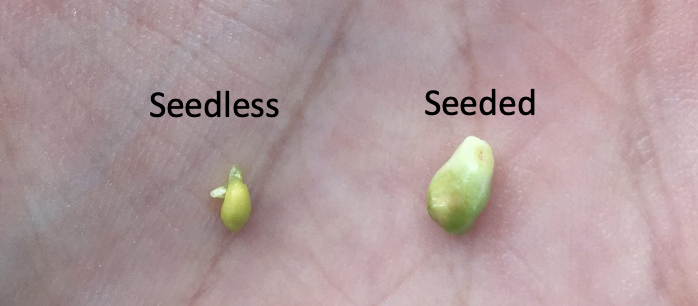
In seedless grapes, a mechanism called stenospermocarpy impacts the development of that embryo. Most of the process of creating a seed still occurs for seedless grapes: pollen blows onto a flower and fertilizes it. A fruit begins to develop from this fertilization event, resulting in clusters full of grapes that are the size of peppercorns. The seeds inside those grapes do not contain a viable embryo, however, and so the seeds do not develop even while the rest of the grape swells and ripens. When you cut a seedless grape open, you can still see a trace of the undeveloped seeds inside of the fruit!
Without developed seeds, it is natural to wonder how the vines for seedless grapes are grown and how new varieties are bred. Without seeds to plant, where did the vines come from? The answer is that plants don’t always need to reproduce via the birds and the bees. They can also create baby plants via clonal propagation. Many plants reproduce clonally in the wild (including grapevines) by developing roots at certain growing points along their stems. If those roots come in contact with soil, they will dig in and establish a new daughter plant that is genetically identical to the mother plant. Humans have been taking advantage of this phenomenon for thousands of years to reproduce plants that have characteristics we enjoy, such as seedlessness in grapes. This is how vineyards can grow many rows of the same cultivar without needing to use seed. The original seedless grapevine might’ve had a hard time reproducing on its own, but humans have helped it on its way.

Even though we understand how seedlessness happens, it doesn't always mean that we know where it comes from. The aforementioned embryo is halted in its development by a Seed Development Inhibitor, or SDI, and scientists are looking for the genes that cause this. Recent research has shown that seedlessness may be caused by a gene that is located on a relatively small region of chromosome 18.
Knowing which gene causes the SDIs to be produced and where it is located can allow future breeders to cross this gene into new table grape varieties that have other desirable traits. In fact, although the immature seeds from seedless grapevines can't be planted in the soil, grape scientists have developed ways to grow these seeds in sterile conditions. Although the success rate isn’t always high, these underdeveloped seeds can grow into mature vines, and grape breeders can create new varieties using seedless parents. The best of these varieties can then be easily reproduced using clonal propagation techniques. Breeders from across the industry and within VitisGen3 are creating more sustainable varieties that are drought and disease resistant, more productive, and potentially tastier.

So there is no need to lose sleep over seedless grapes, and every reason to keep enjoying them as a delicious and nutritious snack! Because of the work of grape researchers and breeders, we can look forward to the next generation of seedless grapes and enjoy them for many years to come.